Star Embroidery Designs
A Designer’s First Look: Simple, Sparkling, and Surprisingly Versatile
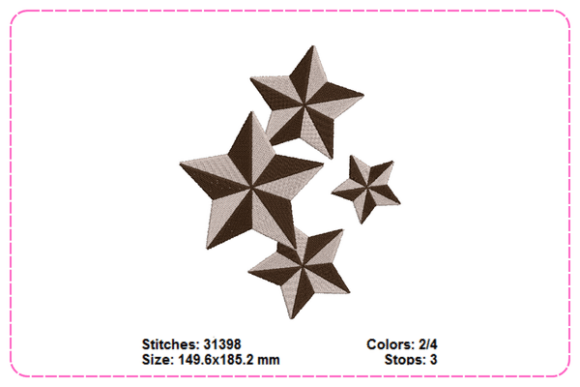
When I opened Star Embroidery Designs for the first time, my eye went straight to its balance—clean outer points, a softly rounded center, and just enough internal detail to feel intentional without overcomplicating. It doesn’t shout “Christmas,” but it leans in gently: think winter nights, quiet celebrations, handmade ornaments, or a subtle nod to holiday cheer on a baby onesie—not tinsel overload. That’s a win. As a designer who tests dozens of embroidery files each month for client work and small-batch production, I appreciate when a design breathes. This one does.
Real-World Use: From Tote Bag to Tiny Onesie
Last week, I used Star Embroidery Designs on a natural linen tote bag for a local boutique’s holiday collection. We placed it centered on the front panel, sized at 3.2”, with soft ecru thread on oat-colored fabric. The result? Crisp, confident, and quietly special—exactly what their customers expect from handmade product. No pixelation, no skipped stitches, no “muddy” fill areas. Later, I scaled it down to 1.8” for a set of organic cotton baby burp cloths. Even at that size, the points held shape and the satin stitch edges stayed smooth—no fraying or distortion after washing.
It also translated beautifully onto a loop-wheel sweatshirt (medium-weight fleece). With proper cutaway stabilizer and reduced top tension, the design laid flat and retained dimension without stiffness. That’s not guaranteed with every star motif—some collapse or lose definition on textured surfaces. Star Embroidery Designs handled it with ease.
Where It Shines—and Where to Pause
Shines on:
- Home decor: Towels, pillow covers, and tea towels—especially with tonal thread choices that let the shape do the talking.
- Apparel: Sweatshirts, lightweight jackets, and structured caps (when hooped carefully).
- Personalized gifts: Embroidered patches sewn onto denim jackets, monogrammed aprons, or nursery wall hangings.
- Etsy listings: Works well in printable mockups—its clarity reads instantly on screen, helping buyers visualize the finished product.
Use with care on:
- Thin or stretchy fabrics like jersey or rayon challis—always test with tear-away + light cutaway stabilizer.
- Dark fabric backgrounds—check how the fill stitch density holds up; some stars get visually heavy if the inner fill is too dense.
- Curved surfaces like baseball caps—hoop alignment matters more here. A 4” hoop works better than a 3” for consistent point definition.
- Small hoop sizes under 3”—the tips can soften if the file wasn’t digitized for micro-scaling. Always verify stitch integrity at your target size.
Design Integrity Meets Customer Trust
What makes Star Embroidery Designs reliable isn’t just how it stitches—it’s how it *lands*. Customers notice clean edges, balanced spacing, and thoughtful thread transitions. When you use this design on a custom embroidered tote bag or a boutique sweatshirt, it subtly reinforces professionalism. No jagged corners. No floating threads. No guesswork about where the motif ends and the fabric begins. That consistency builds trust—especially for Etsy sellers and craft fair vendors whose reputation rides on perceived quality.
I’ve seen similar star motifs fall apart in commercial embroidery: over-digitized fills that pucker, inconsistent satin stitch angles, or poorly nested elements that shift during stitching. Star Embroidery Designs avoids those pitfalls. Its layout feels purpose-built—not just drawn, but *engineered* for real machines and real fabric.
Practical Designer Notes You’ll Actually Use
Before committing to production, here’s what I always do—and recommend you do too:
- Test on scrap fabric that matches your final substrate, using the same stabilizer and thread colors.
- Check thread color contrast—a pale gold on cream linen reads differently than navy on charcoal. Try it in grayscale mockups to assess value separation.
- Review stitch density visually in your embroidery software. If fill areas look overly tight or sparse, adjust underlay or density settings before stitching.
- Confirm hoop size compatibility. If your machine has limited hoop clearance (e.g., on a cap frame), measure the design’s bounding box—not just its stated size.
- Inspect small details at 200% zoom: Are star points sharp? Do satin stitch edges taper cleanly? Is there unnecessary running stitch travel?
- Verify licensing before selling finished items or bundling the file as part of a digital product. Not all embroidery files permit commercial use out of the box.
Fitting Into Your Creative Workflow
Whether you’re an apparel decorator adding holiday flair to crewnecks, a craft business owner prepping for Christmas markets, or an Etsy seller curating digital embroidery bundles, Star Embroidery Designs slots in without friction. It pairs effortlessly with monograms, simple text blocks, or even other seasonal motifs—like tiny snowflakes or minimalist trees—without visual competition. Its scale flexibility means one purchase serves multiple needs: a bold chest logo on a sweatshirt, a delicate accent on a baby blanket, or a repeating border on kitchen towels.
Most importantly, it feels *handmade*—not mass-produced. That warmth matters. In a market flooded with generic clipart-style embroidery, Star Embroidery Designs carries quiet intention. It’s the kind of detail that makes someone pause, run a finger over the stitching, and say, “Who made this?”
Final Thought: Less Is Truly More
This isn’t a flashy, over-the-top holiday embroidery file. It doesn’t need bells or glitter effects to earn its place. Its strength lies in restraint: balanced proportions, smart digitizing, and adaptability across fabric types and use cases. For designers and makers who value clarity over clutter—and craftsmanship over convenience—Star Embroidery Designs earns repeat use. Not because it’s perfect in every way, but because it’s consistently right where it counts.