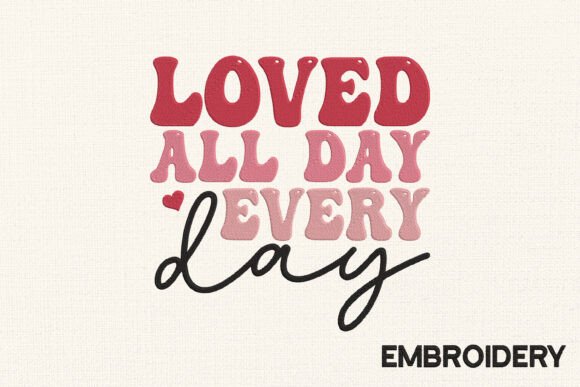
Loved All Day Every Day Embroidery
First Impression: Soft, Timeless, and Thoughtfully Romantic
As an embroidery designer who’s prepped over 200 craft fair booths—from snowy holiday markets to sun-drenched spring bazaars—I opened Loved All Day Every Day Embroidery expecting something sweet but safe. Instead, I found a quietly confident design that lands right between heartfelt and elegant—no glitter, no cartoon hearts, no forced whimsy. It reads as soft romantic rather than sugary Valentine S Day cliché. That nuance matters. At a craft fair, where shoppers scroll past dozens of “XOXO” and “Be Mine” designs in under ten seconds, Loved All Day Every Day Embroidery stands out by breathing slower. It feels like a handwritten note tucked into a handmade gift—not a shout, but a sincere pause.
Where It Shines: Real Craft Fair Product Pairings
This design thrives on pieces that carry emotional weight *and* daily utility. On a linen tea towel? Perfect—it elevates kitchen gifting without looking “too special to use.” On a heavyweight cotton tote bag? Yes. The phrase flows naturally across the center panel, legible at arm’s length, with rhythm that invites touch. As apron embroidery? Strong choice—especially on muted denim or oat-colored canvas—where it reads as artisanal, not promotional. As an embroidered patch? Highly effective for layering on denim jackets or market bags; its balanced letter spacing and gentle curve hold up beautifully when cut and ironed.
It also works surprisingly well on pillow covers and small fabric pouches—but only if stitched at 3.5"–4.5" wide. Smaller than that, and the subtle kerning and soft serif influence begin to blur. Avoid placing it on curved cap surfaces unless you’re using a high-quality commercial embroidery machine with advanced tension control—the phrase’s even flow doesn’t forgive distortion.
Photography & Online Appeal: A Quiet Seller
Loved All Day Every Day Embroidery photographs exceptionally well for Etsy sellers and small shop product listings. Its clean line weight and moderate stitch density render crisply in natural light—no harsh shadows or thread pooling to hide in post-processing. Unlike dense floral monograms or tightly packed script designs, this one breathes on camera. Pair it with neutral backdrops (stone, raw wood, unbleached cotton), and it reads as premium, intentional, and handmade—not mass-produced. For printable mockups, it scales cleanly across sizes, making it easy to generate cohesive design assets for social media, email banners, and booth signage.
What Buyers Notice First (and Why It Converts)
- Legibility at distance: Shoppers scanning your booth table instantly recognize the phrase—not just the sentiment, but the *tone*. That builds trust before they even pick up the item.
- Emotional resonance without cliché: It speaks to enduring love, not just February 14th. That extends shelf life beyond Valentine S Day—ideal for year-round handmade product lines.
- Tactile harmony: When stitched with matte cotton thread on natural fiber fabrics, it feels warm and human—not stiff or digital. That handmade quality translates directly to perceived value.
Production Reality Check: What You Must Test Before Booth Day
Don’t assume this design will run flawlessly straight from download. As a working embroidery designer, I recommend these practical steps before cutting your first production run:
- Test on scrap fabric matching your final product—especially textured tea towels or thick twill for aprons. Stitch density may shift visibly on looped terry or heavy duck cloth.
- Check thread contrast on both light and dark fabrics. Light gray or navy thread often reads richer than stark black on charcoal linens; avoid white thread on off-white toweling—it disappears.
- Confirm hoop size compatibility. This isn’t a tiny accent—it needs room to land gracefully. If your machine’s standard hoop is 4"x4", you’ll likely need a 5"x7" for optimal spacing and stability.
- Use tear-away + light cut-away stabilizer combo for medium-weight cottons; skip heavy cut-away unless stitching on unstable knits—it dulls the softness this design relies on.
- Create at least one real mockup—not just a digital preview. See how the phrase sits on your actual tote bag’s gusset or how it anchors a pillow cover’s corner.
- Compare fabric colors side-by-side. Oat, clay, heather gray, and ivory all change how the letterforms read—some mute the warmth, others amplify it.
- Verify commercial licensing before selling finished products. Since the description mentions “commercial embroidery,” confirm scope—does it include unlimited physical items? Resale rights? Bundling with other designs?
Craft Fair Booth Strategy: Making It Your Anchor Design
In my experience, Loved All Day Every Day Embroidery performs best as a *visual anchor*, not a standalone novelty. Place it on your largest, most tactile item—a heavyweight market bag or a set of two coordinated tea towels—and let it draw people in. Then support it with complementary pieces: a minimalist embroidered patch on a denim cap, a small pouch with the phrase subtly curved along the zipper pull, or a folded card with the same script printed beside a hand-stitched sample. This creates narrative cohesion—your booth tells a story about care, consistency, and quiet intention.
It also strengthens brand consistency across platforms. Use the same phrase styling in your Etsy banner, Instagram highlights, and printed price tags. That repetition builds recognition faster than any logo ever could.
Final Designer Note: Less Is Truly More Here
This isn’t a design that begs for embellishment—no need to add hearts, vines, or borders. Its strength lies in restraint. Over-stitching, excessive fill, or aggressive color blocking undermines its calm authority. Let the phrase breathe. Let the thread catch the light gently. Let the fabric show through where appropriate. In a market saturated with loud, fast, and fleeting, Loved All Day Every Day Embroidery earns attention by being unhurried—and that’s exactly why craft fair shoppers reach for it, again and again.